Austin, Texas · for families

Moving to Austin
with kids.

The best Austin neighborhoods for families, by school district. What Eanes costs versus AISD versus the suburbs, what the AISD funding crisis means for 2026, and what r/AustinParents actually says.

Quick answer

Should you move to Austin with kids?

Yes if your school decision is sorted before you sign a lease or close on a house. Eanes ISD homes (the Westlake area) run roughly two to three times the price of equivalent homes in suburban districts like Round Rock or Leander, and roughly twice the price of the central AISD neighborhoods. Austin is a real place to raise kids, with one of the most kid-friendly cultures in the country. Choose the school district first.

No if you cannot afford the school district your kid needs and you are planning to figure it out after the move. The AISD funding crisis of 2024 to 2026 makes that bet riskier than it was three years ago.

The Texas no-state-income-tax savings on a $250,000 married household are roughly $9,000 to $13,000 a year. The school-district premium can eat that math in a single year. Run your specific numbers → Moving without kids? See the young-professional version of this guide.

Editor's note

Pick the school district before you pick the house.

The single biggest mistake families make moving to Austin is treating the school decision as something to figure out after they get here. It is not. The school district determines the home price, the commute, the social structure of your neighborhood, and the trajectory of your kid through middle and high school. Almost every other relocation question follows from it.

The decision is real and it costs real money. A 4-bedroom home in Eanes ISD runs roughly twice what an equivalent home in a strong AISD neighborhood costs, and three times what the same house costs in Round Rock or Pflugerville. The premium is not arbitrary. It reflects a small district with consistently top-tier ratings, robust arts and athletics programs, and a stable funding base that AISD does not currently have.

That last part matters more in 2026 than in 2022. Austin Independent School District is in the middle of a multi-year funding crisis. The board closed ten schools in late 2025, cut campus staff and librarians, and is staring at a $181 million shortfall heading into 2026 to 2027. The Texas Education Agency 2024 accountability ratings still show AISD as B-rated overall, but campus-by-campus dispersion is wider than it was three years ago. Families currently weighing AISD versus Eanes versus the suburbs are weighing a different math than families did then.

This guide walks through the school decision first, the neighborhoods that match each path, the cost math, and what the threads from r/AustinParents say about actually living the result.

Nathaniel Peters, Founder & Editor
Landed analysis

The Austin school-district premium, by the numbers.

Median 4-bedroom single-family home prices by major Austin-area school district, mid-2025 to early 2026. Approximate values pulled from Austin Board of Realtors monthly reports and Zillow Home Value Index data, segmented by ZIP-to-district mapping.

A 4-bedroom home in Eanes ISD costs roughly three times what the same home costs in Pflugerville or Round Rock, and roughly twice what it costs in central AISD neighborhoods. Source: Austin Board of Realtors monthly reports, Zillow Home Value Index, 2025-2026. Aggregated by Landed; individual home prices vary widely by lot size, condition, and exact street.
Eanes ISD (Westlake) ~$1.8M median AISD central ~$1.2M median AISD north (Hyde Park) ~$900K median AISD east (Mueller) ~$700K median Leander ISD ~$550K median Round Rock ISD ~$500K median Pflugerville ISD ~$430K median

The premium is real and it compounds. A family choosing Eanes over Round Rock is making a roughly $1.3 million purchase-price decision over the same square footage. Financed at standard mortgage rates, that delta is roughly $7,000 to $8,000 a month in additional housing cost over the life of the loan, before property tax. Travis County effective property tax adds another $25,000 to $35,000 a year on the Eanes home.

The AISD-vs-suburb decision is structurally similar. A central AISD home runs roughly twice the suburban-district cost for the same number of bedrooms. The 2024-2026 AISD funding crisis has not yet meaningfully softened the central-Austin premium because the Mueller, Hyde Park, and Bouldin neighborhoods retain demand from buyers who are not relying on the public school as the determinative factor.

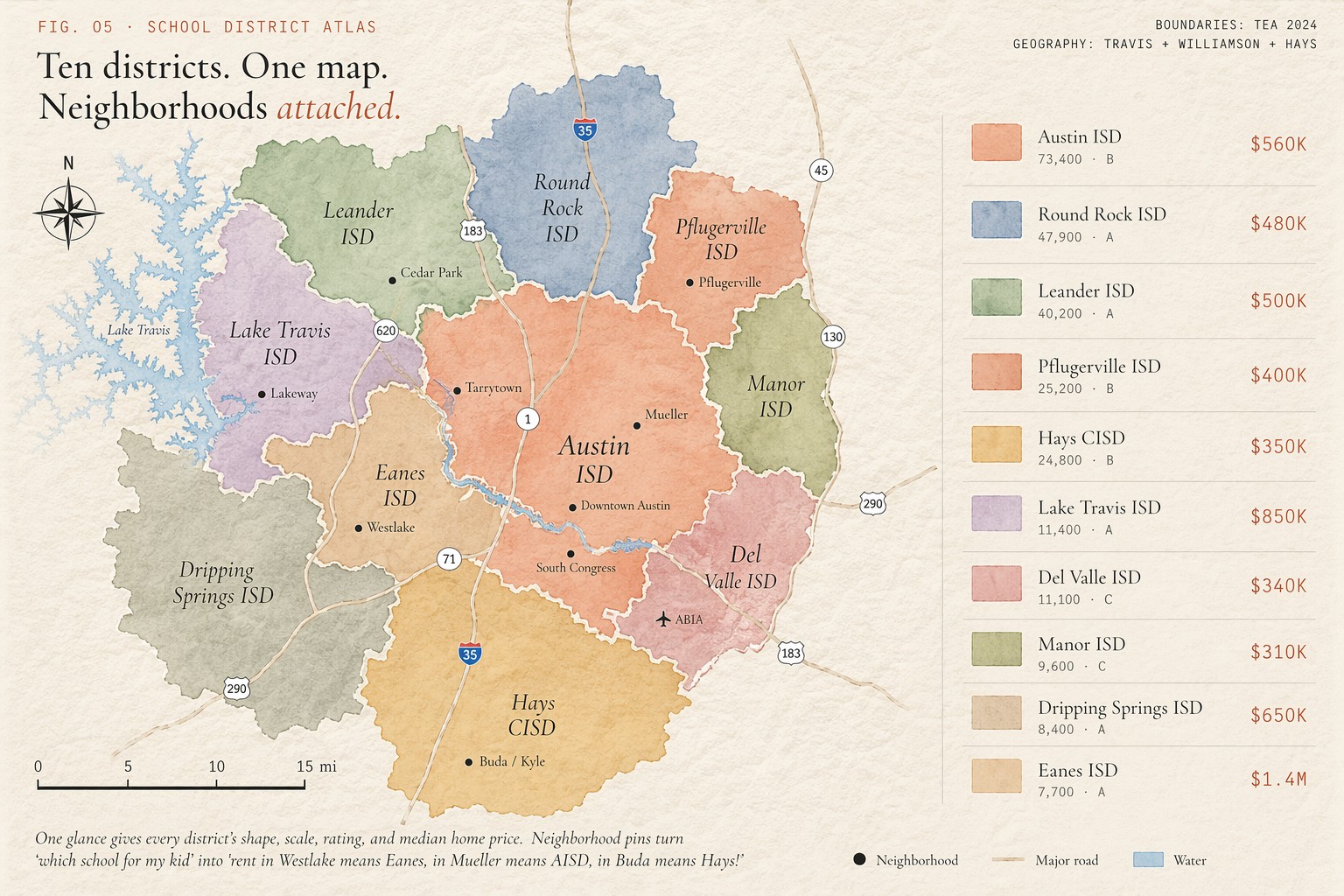
A map of the major Austin-area school districts, showing Eanes, Lake Travis, Leander, Round Rock, Pflugerville, Austin ISD, Hays, Manor, and Del Valle, each outlined and labeled, with a legend listing student count, TEA rating, and median home price.

Where the Austin-area school districts actually sit. The shape of the map drives the shape of the housing decision: the closer to the dense corridor, the higher the cost-of-school decision rises.

What are the school options for families moving to Austin?

The school decision

Eanes, AISD, or the suburbs.

Every other relocation question follows from this one. The 2024-2026 AISD funding crisis has changed the inputs.

The Austin family-school decision in 2026 is effectively four paths.

Eanes ISD (Westlake area)

The premium private-public school district. Small (~8,000 students), consistently top-rated by the Texas Education Agency, known for arts and athletics depth. Homes in Eanes run roughly $1.5 million to $3 million for a family-sized house, with the school-district zone overlapping mostly with the 78746 ZIP code in West Lake Hills. The decision to live in Eanes is the decision to spend a multi-million-dollar premium for school-determined access.

Central AISD (Mueller, Hyde Park, Bouldin, Tarrytown)

The walkable-city-with-public-school path. Strong individual schools (Mueller, Casis, Highland Park Elementary), with the trade-off that AISD as a district is in the middle of a serious funding crisis. An April 2026 r/Austin thread from a parent of two AISD kids (2,525 ups, 655 comments) laid out the cuts: ten schools closed in late 2025, campus staff and librarian roles eliminated, a $181 million shortfall heading into 2026 to 2027. The parent in the thread did not say AISD families should leave. The thread did say what is happening, with primary documents.

Suburban districts (Round Rock, Leander, Pflugerville)

The bigger-house-on-a-bigger-lot path. Round Rock and Leander schools are well rated by TEA and have stable funding. The trade-off is the commute (40 to 60 minutes into central Austin in peak traffic) and the loss of the dense-corridor social geography. For families whose work is also suburban, this path is straightforward and considerably cheaper than central or Eanes. For families whose work is downtown or central east Austin, the math gets harder.

Private schools (St. Andrew's, St. Stephen's, Trinity, Headwaters)

The opt-out path. Private school tuition runs $25,000 to $40,000 per year per kid in Austin. For families with two or three kids, that is $75,000 to $120,000 a year, every year, K through 12. Families who go this route are usually doing so to live somewhere central and walkable without having to gamble on the school assignment.

An aerial view of Lake Austin homes along a tree-lined shoreline, in the Westlake / Eanes ISD area.

Lake Austin from above. The Eanes ISD homes here run roughly $1.5 million to $3 million, against $400,000 to $550,000 for equivalent homes in the suburban districts. The school-district premium is the single largest line item in a typical Austin family relocation.

What are the best school districts in Austin?

The ten districts at a glance

State ratings, college-ready percentages, and what each district actually means.

Compiled from Texas Education Agency 2024 accountability ratings, district enrollment filings, and Texas Academic Performance Reports.

The most-asked-about district

Eanes ISD A

Westlake area · ZIP 78746 · West Lake Hills, Rollingwood, parts of Bee Cave

Students
7,700
College ready
87%
Housing premium
$316K to $470K
Median 4BR
$1.8M

The premium-public path. Cost shows up in the housing line, not in tuition. Westlake High routinely ranks in the state top 10 and roughly half of the senior class earns one or more AP-calc-or-higher credits before graduation. The trade is structural: Eanes housing runs two to three times the price of equivalent homes in Leander or Round Rock for the same square footage.

See the math against private school →

The other nine districts, sorted by 2024 Texas Education Agency accountability rating. The "best Austin neighborhoods for families" question almost always reduces to a choice between two or three of these.

Lake Travis ISD

A

Western suburbs · Lakeway / Bee Cave

Students
11,400
College ready
74%

Growing fast. Lake Travis HS ranks top 20 statewide. Housing premium is real and comparable to Eanes.

Leander ISD

A

Cedar Park / Leander

Students
40,200
College ready
71%

Vandegrift and Cedar Park HS regularly rank in the state top 10 percent. New construction, large campus footprints, strong PTAs.

Dripping Springs ISD

A

Southwest Hill Country

Students
8,400
College ready
70%

Small district, strong scores, semi-rural character. Commute to central Austin runs 35 to 50 minutes.

Round Rock ISD

A

Round Rock / north Austin

Students
47,900
College ready
68%

Strongest balanced district at scale. Westwood is top-tier; Round Rock HS is the legacy; McNeil is newest. Three high schools that are not interchangeable. Zone carefully.

Hays CISD

B

Buda / Kyle

Students
24,800
College ready
59%

Meaningfully more affordable than the west-side districts. Lehman HS and Johnson HS split the enrollment.

Austin ISD

B

Central Austin

Students
73,400
College ready
58%

Huge range by campus. Central and west Austin schools outperform; east and south lag. LASA magnet is elite, with a competitive eighth-grade admissions test.

Pflugerville ISD

B

Northeast metro

Students
25,200
College ready
55%

Often confused with Round Rock geographically. Hendrickson HS is the academic standout. Housing is meaningfully cheaper than RRISD or LISD.

Del Valle ISD

C

Southeast / airport corridor

Students
11,100
College ready
45%

Wraps the southeast: the airport, parts of East Riverside south of Oltorf. Zoning gets confusing. Verify on the Travis CAD address lookup before you offer.

Manor ISD

C

Due east / 290 corridor

Students
9,600
College ready
40%

Manor New Tech HS is a project-based magnet with a meaningfully better outcome profile than Manor HS. Lowest housing entry price in the metro.

Source: Texas Education Agency 2024 Accountability Ratings, district enrollment filings, Texas Academic Performance Reports. College-ready percentages are statewide-criteria readiness in English Language Arts and Math, four-year graduation cohort.

Landed analysis

When does private school start to make sense?

Four paths, one K-12 cost. Computed for one child over the thirteen-year arc, using Austin Board of Realtors median home prices and Independent Schools Association of the Southwest tuition data, 2025 to 2026.

The four ways an Austin family pays for K-12, totaled over thirteen years per child. The Eanes housing premium and average private tuition are within $73K of each other on a one-child basis, which is what makes the second-child math the actual decision. Source: Austin Board of Realtors monthly market reports (housing premium), Independent Schools Association of the Southwest 2025 tuition averages (private), Landed calculations.
Path A · AISD transfer $0 · tuition-free, housing decides quality Path B · Eanes housing premium ~$220K, paid once in housing (~$17K / yr imputed) Path C · Private K-12, average ~$293K, paid yearly ($22.5K / yr) Path D · Private K-12, top-tier ~$520K ($40K+ / yr)

One child: Path B (Eanes) at $220K beats Path C (average private) at $293K by roughly $73K over thirteen years. The math is closer than it looks because Path B is paid up front in the mortgage and Path C is paid yearly out of cash flow. For a one-child household with a tight monthly budget but a big down payment, Path C may actually be easier to absorb. The pure dollar winner is Path B.

Two children: Path B is unambiguously the cheapest non-AISD path. Two kids at average private is $586K. The Eanes housing premium does not change with the second kid. The savings are roughly $366K over the K-12 arc. This is why most Austin families with two or more school-age kids who are already willing to spend on schooling end up in Eanes rather than private.

Three children: Path B saves close to $660K against Path C. The Eanes premium effectively prices each additional child at zero, while private school prices each child at full tuition.

The breakeven against Path A (AISD): The AISD-transfer path is free if your zoned school works and you can avoid moving for high school. The risk is that AISD’s 2024 to 2026 budget crisis (ten schools closed, $181 million shortfall) raises the chance that your school changes between kindergarten and twelfth grade. Most central-Austin parents with the means to consider Path B or C are pricing in that risk explicitly when they decide.

What are the best Austin neighborhoods for families?

Where to actually live

The neighborhoods that match the school path.

In r/AustinParents, the recommendations cluster tightly. Twenty years of Realtor commentary agrees with them.

The best Austin neighborhoods for families fall into three groups, sorted by what you are optimizing for. The trade-off in each case is school district versus housing cost versus commute. There is no path that wins on all three.

If your priority is walkability plus public schools and you are willing to accept the AISD risk:

  • Mueller. The most-cited family-friendly Austin neighborhood in the threads. Walkable, with parks, an HEB grocery, a Sunday farmers market, and a designed-from-scratch street grid. Schools are AISD. Median 4BR home around $700,000.
  • Brentwood / Crestview. In a December 2025 r/AustinParents thread on best kid-friendly neighborhoods, u/mirach (22 ups) wrote: "We moved away but lived in Brentwood and it's what you want. Walking distance to multiple coffeeshops, big park that you see the same people at, lots of families and people are friendly." AISD, brand new Brentwood Elementary.
  • Northwest Hills. Slightly outside the dense corridor but with strong walkability and AISD schools. From an October 2024 r/AustinParents thread, u/moonflower311 (12 ups) summarized it: "I live in Northwest Hills and it pretty much ticks all boxes but the price."
  • Hyde Park. Older AISD elementary schools, more pre-war housing stock. Best for families willing to accept smaller lots and less new construction in exchange for the canopy and the walkability.

If your priority is school certainty, regardless of price:

  • West Lake Hills / 78746. The Eanes path. Premium in dollars, but the school question is settled.

If your priority is space and a lower price tag, with a longer commute:

  • Cedar Park / Leander. Leander ISD. Newer housing stock, master-planned communities, larger yards.
  • Round Rock. Round Rock ISD. Established suburban grid, good public school ratings, more affordable than Leander on average.
  • Pflugerville. The most affordable of the major suburban paths. Pflugerville ISD ratings are slightly below Round Rock and Leander.
  • Circle C Ranch. South of central, technically still in AISD but with its own elementary and a planned-community feel. From the same r/AustinParents thread, u/ashaahsa (12 ups): "Circle C has been part of Austin since 1997. Fair enough wanting to live more centrally, but it's still COA and AISD, as opposed to Round Rock."

Katherine Staas, an Austin real estate agent at the Schmitz & Smith Group, framed the long-run logic in her February 2026 family-neighborhood guide: "Areas with good schools consistently attract buyers and renters. This creates strong long-term demand, which helps protect your investment." The school district premium does not just buy schooling. It buys resale stability.

A residential street in Austin's Mueller neighborhood, with sidewalks and front porches.

Mueller, the most-cited family-friendly central neighborhood in r/AustinParents threads. AISD elementary, walkable to a grocery store and parks, median 4BR home around $700,000.

A school in the northern Austin suburbs, with a covered drop-off lane and trees in the background.

A suburban Austin school. The Round Rock, Leander, Pflugerville, and Cedar Park districts together enroll more than 110,000 students. They are where most Austin-area families with school-age kids actually live.

What does it cost to raise a family in Austin?

What it actually costs

A family of four in Austin in 2026.

Beyond the home price, three line items most families underestimate.

Childcare

Full-time daycare in central Austin runs $1,800 to $2,400 a month per child for infants and toddlers, dropping to $1,400 to $1,800 for preschool. A family with two kids under five can expect $3,500 to $4,500 a month in childcare, before any after-school or summer-camp costs once kids enter school. The Texas no-state-income-tax savings on a $250,000 married household, roughly $9,000 to $13,000 a year, do not cover one kid's annual daycare.

The school-district home premium

Already discussed above. For most families, this is the largest cost in the move. A 4-bedroom Eanes home runs $1,000 to $1,500 a month more in mortgage payment than the same home in Round Rock, before property tax differential.

The everything-else creep

The threads from working-age Austin parents are unusually consistent on the same observation. In an October 2025 r/Austin thread (1,008 ups), u/Busy_Struggle_6468 (501 ups) put it directly: "Alcohol and dining out will bankrupt you in this town no matter how much you earn. Once I learned to enjoy home life and treat the bar and restaurant outings like a rare treat, my bank account thanked me." Austin's restaurant culture is one of its best features and one of its more expensive ones, and family schedules amplify rather than dampen the cost: a single restaurant outing for four runs $80 to $140 in central Austin in 2026.

Is Austin a good place to raise kids?

Austin as a place to raise kids

The kid-friendly culture is real.

The threads on this point are unusually positive, even from skeptical posters.

For all the school-district complexity, Austin's culture toward kids is a genuine asset. In a November 2025 r/Austin thread from a new parent who said the city had been unexpectedly welcoming (561 ups), u/Peter_Puppy (84 ups) made the comparison directly: "Folks don't realize how kid friendly Austin is. Breweries with playgrounds seems to be an Austin phenomenon. Kids are just tolerated in Denver, Seattle, Portland. Here families are embraced and welcomed."

The infrastructure backs the culture up. Austin has an unusual concentration of kid-and-parent-friendly third places: breweries with playscapes, restaurants with kids' menus that are not afterthoughts, libraries with weekly story times in every neighborhood, the Thinkery children's museum at Mueller, and a public-park network that gets meaningfully more usable from October through April.

In a July 2025 r/AustinParents thread on the best areas to raise kids, u/mirach (7 ups) summarized it for a European parent who had moved to a downtown apartment and felt isolated: "Austin I'd say is actually top tier in the US in kid friendly places. Other cities are not on the same level as Austin with this. I don't know where you've been, but there are a ton of cafes, restaurants..." The catch in the thread, repeatedly raised, was that kid-friendly density requires getting out of the downtown apartment and into a neighborhood with sidewalks. Mueller, Brentwood, Hyde Park, Northwest Hills.

A person at a playground in Austin, Texas, with a tube slide and surrounding park structures.

A playground in central Austin. The kid-friendly culture is real and is one of the strongest signals from the resident threads.

Folks don't realize how kid friendly Austin is. Breweries with playgrounds seems to be an Austin phenomenon. Kids are just tolerated in Denver, Seattle, Portland. Here families are embraced and welcomed.

Public threads.
Primary data.
Named editor.

That’s Landed.

The honest verdict

Pick the school path. Then pick the house.

Austin with kids in 2026 makes sense if you have decided which of the four school paths fits your family before you sign anything. Eanes for school-determined access. Central AISD with eyes open about the funding crisis. Suburbs for space and stability. Private for the opt-out option.

If you have not decided, do not move yet. The relocation is too expensive to figure out from the inside. The school decision affects the home you can afford, the commute you will absorb, and the trajectory of your kid through the next twelve years. None of those are reversible cheaply. Read the full Austin guide for the rest of the picture, run the cost calculator against your specific salary, and check the neighborhoods page for the long-form take on each.

The good news in all of it is the part the Reddit threads keep coming back to. Austin is unusually kind to families. The restaurants have changing tables. The breweries have playscapes. The neighborhoods have sidewalks where the kids of two or three nearby families ride bikes together at 6 p.m. That is the part the school-district math does not capture, and it is the part that holds families here once the home and the school are settled.

Nathaniel Peters, Founder & Editor