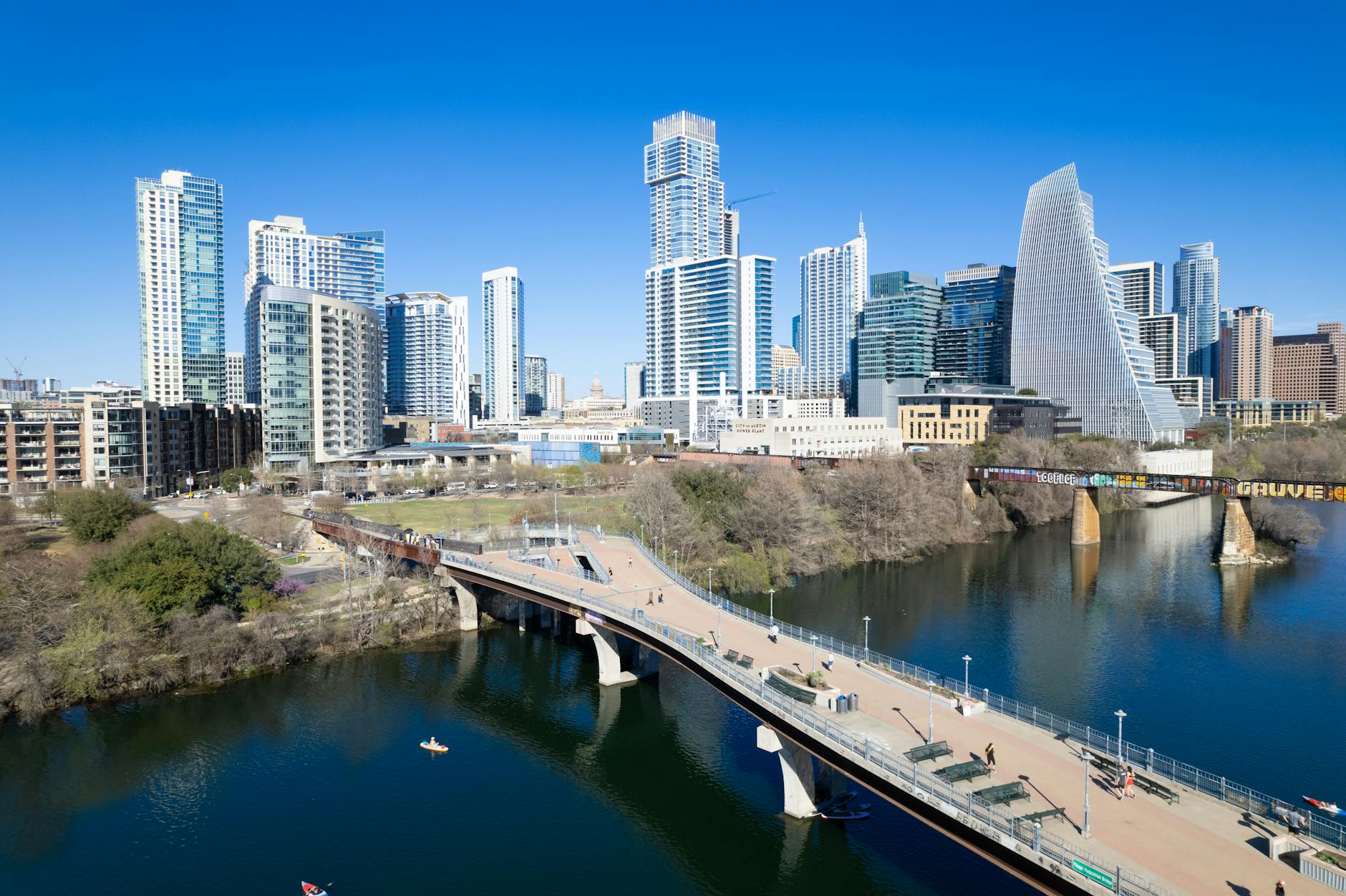
Austin, Texas · from California

Moving from California
to Austin.

The 2026 tax math, the property tax that eats it back, where 4,617 California returns actually landed last year, and what the threads say about the move from the people who stayed.

Quick answer

Should you move from California to Austin?

Yes if your household income clears about $200,000, you are not buying the version of Austin the 2018 think pieces sold (it is gone), and you can afford rent in the dense corridor on day one. The income-tax savings are real and they compound at higher salaries. The square footage you can afford is meaningfully larger.

No if your move depends on Austin being a cheaper version of San Francisco, you are skipping the dense corridor for the suburbs as your first move, or you have not priced the property tax and homeowner insurance into the math. The deal compresses fast at moderate incomes.

The headline tax savings are gross, not net. Run your specific numbers → Moving with kids? See the family version of this guide. Moving in your 20s? See the young-professional version.

Editor's note

The California-to-Austin move is a tax decision that compounds, and a lifestyle decision that does not.

The headline pitch on California-to-Austin is the tax math. For a $300,000 W-2 single filer, the move frees about $24,000 a year in state income tax. For a $500,000 married household, it frees about $39,000. Those numbers are real, per Tax Foundation 2024 brackets. They compound year over year. They are also the central reason the Bay-to-Austin tech pipeline runs as deep as it does.

The eat-back is also real. Travis County effective property tax runs roughly 1.9 to 2.1 percent of appraised value before homestead exemption, against California's 0.71 percent average (Proposition 13 caps reassessment, which holds California's effective rate down even as nominal house values rise). On a comparable home, that delta runs $4,000 to $14,000 a year against you. Texas homeowner insurance runs two to three times the California average, because Central Texas is a hail-loss market. Sales tax in Travis County runs 8.25 percent, against California's typical 8 to 10 percent depending on city, so that is roughly a wash.

The lifestyle decision is harder to model, and the threads from California transplants are unusually consistent on the failure modes. Austin in 2026 is not a cheaper version of California. It is denser than the 2018 version, more expensive than the brochures imply, and culturally specific in ways the listicles do not surface. The dense corridor is the part of Austin where the move works socially. The far suburbs are not the deal Bay Area transplants think they are.

This guide walks through the tax math at six salary tiers, the property tax and insurance eat-back, where Californians actually land in the metro, and what the cultural texture is for transplants from Los Angeles, the Bay Area, and San Diego.

Nathaniel Peters, Founder & Editor
Landed analysis

Where in California the Travis County movers actually came from.

Three regions produced 83 percent of the California-to-Travis County migration in the IRS 2022 to 2023 file. Greater Los Angeles and the Bay Area tied exactly at 1,647 returns each. San Diego County added 530. The headlines focus on the Bay Area, but the count is split evenly between LA and the Bay, and the AGI gap between them is wider than most stories suggest.

Greater LA

1,647

Los Angeles · Orange · Ventura

Avg AGI
$122K
Total AGI
$199M

Largest by count, mid-AGI. Most are dual-income professionals in their 30s. Lands in the dense corridor and Mueller, with a meaningful Orange County contingent in Cedar Park and Round Rock.

Bay Area

1,647

SF · Santa Clara · Alameda · San Mateo · Contra Costa · Marin

Avg AGI
$277K
Total AGI
$456M

Tied with LA on count, but 2.3x the AGI. The high-profile tech-and-venture cohort buys in West Lake Hills and Rollingwood. Senior IC transferees take downtown / Rainey condos and South Lamar.

San Diego County

530

San Diego metro

Avg AGI
$136K
Total AGI
$72M

Structurally similar to LA but smaller. Same neighborhoods (corridor + Mueller), similar career profile. Notable for biotech, defense, and Navy-adjacent transferees.

Computed from IRS Statistics of Income county-to-county migration data, tax years 2022 to 2023. The three regional cards above account for 3,824 of 4,617 total California returns. The remaining 793 came from Sacramento, the Inland Empire, the Central Valley, and the Central Coast in roughly equal shares.

California-to-Travis County migration by origin county, with average AGI per return. Los Angeles County led on count; San Mateo and San Francisco led on income. Source: IRS Statistics of Income, county-to-county migration, tax years 2022 to 2023. Computed by Landed.
Los Angeles County 1,135 returns · $126K avg AGI Santa Clara County 644 returns · $281K avg AGI San Diego County 530 returns · $136K avg AGI Orange County 432 returns · $114K avg AGI Alameda County 361 returns · $158K avg AGI San Francisco County 298 returns · $492K avg AGI San Mateo County 140 returns · $475K avg AGI Contra Costa County 153 returns · $150K avg AGI

The total California flow was 4,617 tax returns and 6,919 people, carrying $830 million in adjusted gross income. California is the largest single non-Texas origin state by a wide margin: roughly two-and-a-half times the next state (Florida, 1,700 returns) and two-point-eight times the third (New York, 1,622). It is also the highest-AGI cohort: average $179,755 per return, against $86,039 for Florida and $135,174 for New York.

The composition matters for what Austin actually feels like to a California transplant. Most of the count comes from Greater LA. Most of the AGI comes from the Bay. The 298 San Francisco returns averaged $492,000 per return, almost four times the LA average. That is the cohort the All-in podcast articles are about, the cohort buying houses in West Lake Hills and Rollingwood. It is also a small share of the actual move. The median California-to-Austin transplant in 2022 to 2023 was a Greater LA professional in their 30s, not a Founders Fund partner.

How much do you save in taxes moving from California to Austin?

Landed analysis

What Texas actually saves a California mover, by salary.

Annual state income tax owed in California, against zero in Texas, computed for a single filer at six tiers using Tax Foundation 2024 California brackets and the standard state deduction.

Annual state income tax savings for a Texas-resident single filer, against the California state income tax at the same salary. The savings curve is non-linear: small at entry-level, large above $200,000. Source: Tax Foundation 2024 California brackets, computed by Landed for a single filer with the standard state deduction.
$65,000 salary $2,217 saved per year $100,000 salary $5,327 saved per year $150,000 salary $9,977 saved per year $200,000 salary $14,627 saved per year $300,000 salary $23,927 saved per year $500,000 salary $44,482 saved per year

For married filing jointly, the savings curve is similar but bracketed slightly differently: about $3,690 saved at $120,000 household, $15,304 at $250,000, $24,604 at $350,000, and $38,554 at $500,000. Most California-to-Austin movers are in the $200,000 to $400,000 household range, so the headline savings number is closer to $14,000 to $25,000 a year than the $19,000 figure that gets quoted out of context.

The savings compound year over year. A $300,000 W-2 earner who stays in Texas for ten years frees roughly $240,000 in cumulative state income tax against staying in California, before considering investment compounding on the saved cash. That is the central reason the Bay-to-Austin tech pipeline is structural, not seasonal.

What does the property tax do to the savings?

The eat-back

Property tax and insurance get back roughly half.

The income tax savings are gross, not net. The two line items most California movers underestimate are the Travis County effective property tax rate and the Texas homeowner insurance market.

California's effective property tax rate averages about 0.71 percent of assessed value, held down by Proposition 13's reassessment cap. Travis Central Appraisal District filings put the Travis County effective rate at roughly 1.9 to 2.1 percent of appraised value before the homestead exemption. The nominal Texas rate is about three times the California rate.

Whether the move is net positive depends on the house you buy. The income tax savings are fixed at your salary. The property tax and insurance eat-back are fixed at your home price. Two realistic scenarios for a Bay-to-Austin transplant who sold a $1.4 million Bay Area home: buy a smaller $700,000 Austin home, or buy a comparable $1.2 million central Austin home.

The eat-back, in numbers

Net annual California-to-Austin savings, after property tax and insurance.

Income tax savings vary by salary. The eat-back is fixed by home price. The intersection is the actual money the move frees up.

Smaller Austin home
$700K Austin · $1.4M Bay sold
Property tax delta
+$4,060/yr
Insurance delta
+$3,027/yr
Eat-back per year
$7,087
Comparable Austin home
$1.2M Austin · $1.4M Bay sold
Property tax delta
+$14,060/yr
Insurance delta
+$3,027/yr
Eat-back per year
$17,087
Net savings, by household income and home choice
Household income Tax saved (gross) Net · smaller home Net · comparable home
$150K single $9,977 +$2,890 -$7,110
$200K single $14,627 +$7,540 -$2,460
$250K married $15,304 +$8,217 -$1,783
$300K married $19,955 +$12,868 +$2,868
$500K married $38,554 +$31,467 +$21,467

Source: Tax Foundation 2024 California single and married brackets, Travis Central Appraisal District 2024 effective rates, Insurance Information Institute 2024 state averages. Net = Texas income tax savings minus property tax delta minus homeowner insurance delta. The eat-back is computed on identical home prices in each scenario. Computed by Landed.

The pattern is what you would expect once it is laid out. Below $300K household, the move only pencils if you also downsize. At a $200K single salary buying a comparable central Austin home, the eat-back is larger than the income tax savings, and the move actively loses money on the math. At a $500K married salary the move is structurally favorable regardless of the house. The narrow band between roughly $250K and $400K is where most California-to-Austin transplants actually live, and it is also where the home-purchase decision is the difference between a financially neutral move and a strongly positive one.

The mitigation is the part most relocation articles do not surface. The genuine savings cohort is: high-income, willing to either downsize or rent for a year while learning the city, and clear-eyed about the property tax line item before the offer is signed. The other cohort, transplants buying a $1.2M central Austin home on a $250K household, is essentially trading San Francisco's housing premium for Travis County's property tax premium. Many of them realize this only after the first appraisal notice arrives.

Aerial of Lake Austin and the Westlake homes that line its south bank, in Eanes ISD.

Lake Austin and the Westlake homes that anchor the high-AGI California cohort. The 298 San Francisco County returns averaged $492,000 in AGI and concentrated in West Lake Hills, Rollingwood, and the central AISD neighborhoods that border them.

Where do Californians actually live in Austin?

Where in Austin

The California cohort lands in three places.

The dense corridor for transplants in their 20s and 30s. Westlake for high-income families. The intra-city tech corridor (Domain, Rainey) for senior tech transfers buying condos.

The best Austin neighborhoods for California transplants are the four that make up the dense corridor. East Austin (ZIP 78702 and 78722), Hyde Park / North Loop (78751, 78705), South Lamar / Bouldin / Travis Heights (78704), and Mueller (78723) are the four neighborhoods that read most like the Bay Area's walkable cores: a coffee shop, a grocery store, three bars, and a recurring social scene within a fifteen-minute bike ride.

The trade against the Bay is real. A 1-bedroom in the dense corridor runs $1,500 to $1,700 a month plus $50 to $100 in mandatory fees, comparable to the Mission or the Outer Sunset, but with meaningfully smaller social density. A November 2025 r/Austin thread ("Did all the Californians move back?") drew 27 ups for u/geofgtian's read: "big tech companies are basically all RTO so all the workers that came in during WFH of COVID are forced to go back for their jobs." The point reverberated in the replies. The dense corridor is real, but the early-2020s influx has moderated.

For high-income families with school-age kids, the cohort concentrates in West Lake Hills (78746, Eanes ISD) and the central AISD neighborhoods that border it: Rollingwood, Tarrytown, and parts of Westover Hills. This is where the average $492,000 San Francisco County AGI cohort actually lives. An October 2025 r/Austin thread on the high-profile Bay Area tech-and-venture transplants pulled 353 ups, with u/momish_atx's reply (197 ups) summarizing the local read on the cohort: "these people don't care one bit about us. They have their own private healthcare, their own private security teams, their own private education for their children." That is the texture of the move at the highest income tier.

For senior tech transfers in their late 30s and 40s buying condos, the third cluster is downtown / Rainey Street (78701) and The Domain (78758). Rainey is the urban-condo answer to the Bay Area's SOMA: walkable, bar-dense, and close to the offices most California transfers work in. The Domain is the suburban-tech answer to Mountain View: master-planned, retail-heavy, and adjacent to the Apple, Google, and Meta Austin offices. Both work for senior tech transferees who do not have school-age kids.

The far suburbs (Cedar Park, Round Rock, Pflugerville) are not the deal Bay Area transplants think they are. The IRS data shows California movers under-indexing on those ZIPs relative to the intra-Texas movers who dominate suburban inflow. The reasons are structural: the social density disappears at the suburb edges, the commute back into the city is the single most-cited regret in r/Austin threads, and the tax math savings get partially eaten back by the second car most suburban households need.

A cyclist on a wide East Austin street with single-story bungalows.

East Austin, the corridor neighborhood most California transplants in their 20s and 30s land in first. The bike-infrastructure quality and the social density of recent arrivals are the closest thing to a Bay or LA core that Austin has.

A South Congress Avenue mural in Austin with vintage signage and pedestrians.

South Congress, the part of Austin that does the visual work the listicles ask of it. The cultural texture beneath the postcard image is what most California transplants under-price, and the most-cited adjustment in the threads.

What is the cultural texture for California transplants?

The cultural texture

Three things California transplants underestimate.

The summer is harder. The food is genuinely different. The state-level political texture is more conservative than the listicles suggest. None of these are dealbreakers. All of them take adjustment.

The summer.

California's coastal climate is the single biggest unstated subsidy of California life. Bay Area transplants who have never lived through a Texas summer underestimate it almost universally. The Travis County 1991 to 2020 NOAA climate normals: 116 days a year over 90 degrees, 28 over 100. August is functionally indoors. The mitigation is real (pool memberships, indoor activities, vacation timing), but the four-month indoor season is the largest lifestyle difference between California and Austin, and it is the most-cited reason in the threads that California transplants leave inside two years.

The food.

Tex-Mex is genuinely different from California-Mexican. Mission burritos do not exist in Austin. Cal-Mex tacos do not exist in Austin. The Austin equivalents (queso-and-brisket, breakfast tacos, Tex-Mex enchiladas) are excellent on their own terms, and the food adjustment is the most-cited "small surprise" in the California-transplant threads. The adjustment usually takes about a year. In the meantime, the closest things to Mission food in Austin are La Condesa (downtown), Suerte (East Austin, more interior Mexican), and Comedor (downtown). None of them are Mission burritos. Accept it.

The politics.

California transplants are usually prepared for the Texas state-level political texture in the abstract and unprepared for it in the specific. The Travis County electorate is solidly Democratic; Austin City Council is to the left of most California cities. State law preempts the city on many of the things Bay Area transplants care about most: abortion access, public school funding, ERCOT regulation, and tenant protections. The state-level layer matters more in Texas than in California, where state policy and city policy are usually aligned. The mitigation is awareness: most Bay-to-Austin transplants who report happiness in the threads have explicitly priced this in.

The smaller-than-Bay reality.

Austin is its own city, not a cheaper version of the Bay Area or Los Angeles. The cultural depth, the airport connectivity, the talent pool for non-tech professional work, and the food scene are all narrower. The mitigation is the part of Austin that is genuinely better than California: the lake, the hill country, the year-round outdoor running, the friend density once you commit to one structured activity, the working two-parent setup at six-figure salaries. A May 2025 r/Austin thread ("No one hates Austin more than Austinites," 602 ups) drew long replies from longtime residents about the city's evolution. The most-upvoted reply, from u/MixSuspicious123 (178 ups): "most native Austinites can't afford to live in their own hometown because people moved here from more expensive markets, jacked up housing prices, and created insane congestion." That is the local read on the move.

How does the Bay-to-Austin career pipeline work?

The career pipeline

The Bay-to-Austin tech transfer route.

The pipeline is real, the org charts exist, and the Austin tech market is no longer absorbing speculative arrivals. The 2026 rule of thumb: come with an offer in writing.

The Bay-to-Austin tech pipeline is structurally large enough that most major Bay Area employers now have Austin org charts deep enough to transfer into. Apple's Austin campus is the second-largest in the country. Google has roughly 1,500 employees in Austin. Meta, Amazon, and Tesla all have multi-thousand-employee Austin presence. Stripe, Atlassian, Indeed, and Block all run engineering offices in Austin.

The 2026 reality is mixed. Bureau of Labor Statistics metro tech employment for Austin sat at roughly 165,000 jobs in late 2025, down from the 2022 peak. Senior IC pay still runs about 85 percent of San Francisco. Entry-level engineering roles run roughly $85,000 to $120,000 base. The market cooled in 2023 and has not fully recovered.

The honest 2026 signal for a Bay-to-Austin tech move: come with an offer in writing. The Austin tech market is not absorbing speculative arrivals the way it was in 2021. A December 2025 r/Austin thread titled "Austin job market bad enough that people are moving out to find work?" pulled 531 ups and a long list of replies confirming the cool-down. The pipeline is paved for transferees and difficult for cold-outreach.

The favorable case is also clear. A senior IC at a Bay Area company who can transfer to the Austin office at the same salary takes home $24,000 to $39,000 more per year in income tax savings, and buys a home for half the price. The math on a transfer is, for most senior tech workers, the most-favorable career-financial decision available within the same job.

Or maybe the fact that big tech companies are basically all RTO so all the workers that came in during WFH of COVID are forced to go back for their jobs.

Public threads.
Primary data.
Named editor.

That’s Landed.

The honest verdict

Three conditions, in order.

The California-to-Austin move pencils when three conditions are true. Your household clears about $200,000 (where the income-tax savings actually compound after the property tax and insurance eat-back). You are not buying the version of Austin the 2018 think pieces sold (it is gone). And you can afford rent in the dense corridor on day one, because the far suburbs are not the deal you think they are.

If all three are true, the move is real and it compounds. The income tax savings free real cash. The square footage upgrade is meaningful. The friend density forms faster than the Bay if you commit to one structured activity by month six. The lake, the hill country, and the year-round outdoor running are not in California.

If any one of the three is false, the move is the most expensive lifestyle change you will ever make, and the regret pattern in the threads is consistent. There is no shortcut around the conditions. Read the full Austin guide for the rest of the picture, run the cost calculator against your specific salary and home price, and check the neighborhoods page for the long-form take on each one. Moving with kids? See the family version of this guide. Moving in your 20s? See the young-professional version.

Nathaniel Peters, Founder & Editor