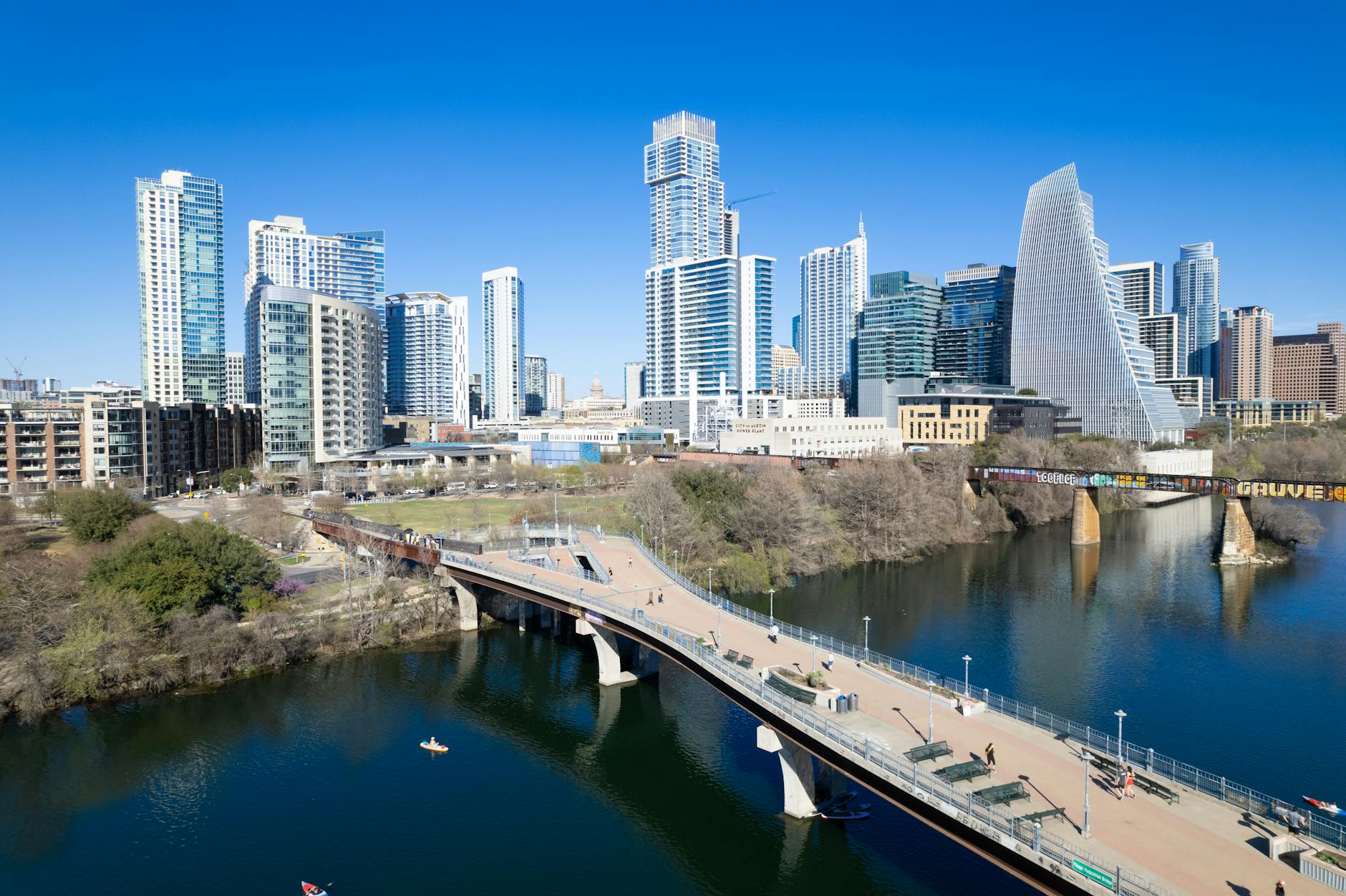
Austin, Texas · from New York

Moving from New York
to Austin.

The 2026 tax math from NYC and beyond, the property tax that moves either way depending on where in New York you came from, where 1,622 NY returns actually landed last year, and what r/Austin says about the move.

Quick answer

Should you move from New York to Austin?

Yes if you are an NYC resident with household income above about $200,000 (where the state-and-city combined tax really compounds), you can afford rent in the dense corridor on day one, and you are willing to commit to one structured activity by month six. NYC has the highest combined state-and-local income tax of any major US city. Texas's zero is the largest single financial swing the move offers.

No if your move depends on Austin matching NYC's energy density (it does not), if family obligations back east will make the four-hour flight a permanent friction, or if you are buying a comparable Austin home on a moderate income, where the property tax line item gets back most of the tax savings.

The headline tax savings are largest from NYC, smaller from Long Island and Westchester, smallest from upstate. Run your specific numbers → Moving with kids? See the family version of this guide. Moving in your 20s? See the young-professional version. Moving from California? See the California version.

Editor's note

The NYC-to-Austin tax math is the biggest of any major migration. The eat-back math depends entirely on where in New York you came from.

NYC has the highest combined state-and-local income tax of any major US city. The combined New York state plus New York City rate runs roughly 9.6 to 10.7 percent at the brackets most transplants are in, against Texas's zero. At a $200,000 single salary, that is a $19,059 a year swing. At $300,000 it is $29,654. At $500,000 it is $51,106. The savings compound year over year. The headline number for NYC residents is meaningfully larger than the equivalent California-to-Austin number at the same salary.

The eat-back math, however, is not symmetric across New York. New York City renters take on a new property-tax-and-insurance burden of roughly $14,000 to $17,000 a year when they buy an Austin home, because the renter had no property tax and minimal insurance. Westchester or Long Island homeowners often save on property tax by moving to Austin, because Westchester and Nassau effective property tax rates of 2.3 to 2.5 percent are higher than Travis County's 1.9 to 2.1 percent. Upstate New York homeowners generally see a wash on property tax, because Erie and Monroe County rates are similar to Travis. The relocation calculator for an NY mover has to start with where in NY you came from.

The lifestyle decision is the part most relocation articles get wrong. Austin in 2026 is not a smaller version of New York. It is denser than the 2018 version, more expensive than the brochures imply, and culturally specific in ways that surprise NY transplants. The dense corridor reads, in the Reddit New Yorker mapping, like a stitched-together version of Park Slope, Carroll Gardens, and Bushwick. The pace is slower. The food is excellent on Tex-Mex, BBQ, and breakfast tacos. There is no NYC-quality pizza or deli. The cultural depth that drove most NYers' lives is meaningfully narrower; the outdoor access that Austin offers is meaningfully wider.

This guide walks through the tax math for NYC residents and non-NYC New Yorkers separately, the property tax and insurance eat-back at both NYC-renter and suburban-homeowner scenarios, where the 1,622 New York returns actually landed in the metro, and what the cultural texture is for transplants from Manhattan, Brooklyn, the suburbs, and upstate.

Nathaniel Peters, Founder & Editor
Landed analysis

Where in New York the Travis County movers actually came from.

Three groups account for the entire New York-to-Travis County flow in the IRS 2022 to 2023 file. New York City's five boroughs produced 65 percent. The NYC suburbs (Westchester, Nassau, Suffolk) produced 18 percent. Upstate New York produced 17 percent. The cohorts have meaningfully different income profiles, and each one has a different relationship to the property tax math.

NYC five boroughs

1,046

Manhattan · Brooklyn · Queens · Bronx · Staten Island

Avg AGI
$145K
Total AGI
$151M

Manhattan and Brooklyn drive the cohort: 437 + 337 returns. Most are renters becoming first-time buyers in Austin. The eat-back from new property tax and insurance is the largest of any NY origin, but the income-tax swing more than offsets at $200K+ single.

NYC suburbs

296

Westchester · Nassau · Suffolk

Avg AGI
$148K
Total AGI
$44M

Highest avg AGI of the three regions. Most are existing homeowners downsizing or rightsizing. Travis County property tax rates are actually lower than Westchester or Nassau, so this cohort often saves on property tax in addition to income tax.

Upstate New York

280

Erie · Monroe · Onondaga · Albany · Saratoga · Dutchess · Orange

Avg AGI
$86K
Total AGI
$24M

Different demographic. Smaller home swap, smaller income-tax swing (no NYC city tax was paid to begin with). Roughly a wash on property tax. The move is more weather-and-job-driven than tax-driven for this cohort.

Computed from IRS Statistics of Income county-to-county migration data, tax years 2022 to 2023. Three regional cards account for 1,622 of 1,622 total New York returns. Manhattan and Brooklyn produced 774 returns between them, more than the entire upstate or suburb cohort.

New York-to-Travis County migration by origin county, with average AGI per return. Manhattan led on count and total AGI; Suffolk and Nassau on per-return average. Source: IRS Statistics of Income, county-to-county migration, tax years 2022 to 2023. Computed by Landed.
New York County (Manhattan) 437 returns · $169K avg Kings County (Brooklyn) 337 returns · $161K avg Queens County 198 returns · $95K avg Nassau County (Long Island) 106 returns · $171K avg Westchester County 102 returns · $98K avg Suffolk County (Long Island) 88 returns · $178K avg Erie County (Buffalo) 74 returns · $75K avg Monroe County (Rochester) 63 returns · $71K avg

The total New York flow was 1,622 tax returns and 2,123 people, carrying $219 million in adjusted gross income. New York is the third-largest non-Texas origin state after California (4,617) and Florida (1,700). It is also the second-highest-AGI cohort: average $135,174 per return, against California's $179,755 and Florida's $86,039.

The composition matters. Manhattan and Brooklyn alone produced 774 returns, more than the entire upstate or suburb cohort. The Manhattan cohort averaged $169K per return; Brooklyn averaged $161K; Queens averaged $95K. Long Island (Nassau plus Suffolk) produced 194 returns at the highest per-return AGI of any NY county pair: $174K average. Westchester and the Hudson Valley produced 124 returns at the most modest average ($90K) for a high-AGI region, suggesting more retirees and remote-workers than primary-job movers.

How much do you save in taxes moving from NYC to Austin?

Landed analysis

What Texas actually saves an NYC resident, by salary.

Combined New York state plus New York City personal income tax owed by an NYC-resident single filer at six tiers, against zero in Texas. Computed using Tax Foundation 2024 New York brackets and NYC Department of Finance 2024 city brackets.

Annual combined state-and-city income tax savings for a Texas-resident single filer, against an NYC-resident single filer at the same salary. The savings curve is non-linear and meaningfully larger at moderate incomes than the California equivalent. Source: Tax Foundation 2024 NY state brackets, NYC Department of Finance 2024 city brackets. Computed by Landed for a single filer.
$65,000 salary $5,805 saved per year $100,000 salary $9,183 saved per year $150,000 salary $14,121 saved per year $200,000 salary $19,059 saved per year $300,000 salary $29,654 saved per year $500,000 salary $51,106 saved per year

The NYC tax savings outperform California at every salary tier. At $200,000 single, an NYC resident saves $4,432 more per year by moving to Texas than a California resident at the same salary. At $500,000 the gap is $6,624 in NYC's favor. That is the New York City local income tax doing the work; the state component is similar to California's.

Non-NYC New York residents (Long Island, Westchester, upstate) pay only the state component, not the city tax. At $200,000 single, a non-NYC New Yorker saves $11,432 by moving to Texas, smaller than the NYC equivalent but still meaningful. The honest framing is that the income-tax pitch on the move is essentially the NYC pitch. The non-NYC New York move depends more on the property tax math and the lifestyle decision than on income tax.

A senior NYC tech or finance professional on a $300,000 W-2 who stays in Texas for ten years frees roughly $300,000 in cumulative state-and-city income tax against staying in NYC, before any compounding on the saved cash. That is the largest single financial decision available to a senior NYC professional inside the same job, and it is the central reason the NYC-to-Austin transfer route is structural in tech and increasingly so in finance.

What does the property tax do to the savings?

The eat-back, by NY origin

Property tax moves either way, depending on where you came from.

The income tax savings are gross, not net. The eat-back looks completely different for an NYC renter than for a Westchester homeowner, because Travis County's property tax rate is lower than Westchester's and higher than Brooklyn's.

Texas homeowner insurance averages $4,456 a year against New York's $1,476, a $2,980 a year added cost on a comparable home, per Insurance Information Institute 2024 averages. That part is the same regardless of NY origin. The property tax math is where the cohorts diverge.

The two scenarios most NY transplants need to model: an NYC renter buying a first Austin home, and a Westchester or Long Island homeowner downsizing to Travis County.

The eat-back, in numbers

Net annual New York-to-Austin savings, after property tax and insurance.

For NYC renters, both lines are new burdens. For Westchester or Long Island homeowners, property tax is actually lower in Travis County. The NYC residency is also where the income-tax savings are largest.

NYC renter buys $700K Austin home
Was renting Brooklyn or Manhattan
Property tax (new)
+$14,000/yr
Insurance delta
+$2,980/yr
Eat-back per year
$16,980
Westchester homeowner downsizes
$900K Westchester sold · $700K Austin bought
Property tax delta
-$7,600/yr
Insurance delta
+$2,980/yr
Eat-back per year
-$4,620
Net savings, by household income and origin scenario
Household income Tax saved (NYC) Net · NYC renter Tax saved (NY state only) Net · Westchester downsize
$150K single $14,121 -$2,859 $8,432 +$13,052
$200K single $19,059 +$2,079 $11,432 +$16,052
$300K single $29,654 +$12,674 $18,151 +$22,771
$400K single $40,506 +$23,526 $24,901 +$29,521
$500K single $51,106 +$34,126 $31,851 +$36,471

Source: Tax Foundation 2024 New York state brackets, NYC Department of Finance 2024 city brackets, Travis Central Appraisal District 2024 effective rates, Insurance Information Institute 2024 state averages. Westchester effective property tax computed at 2.4 percent on a $900,000 home; Travis County at 2.0 percent on a $700,000 Austin home. Computed by Landed.

The pattern is what most relocation articles miss. The Westchester or Nassau homeowner downsizing to Austin is a structurally different financial move than the NYC renter buying a first Austin home. The Westchester downsizer captures both the income-tax savings and a property-tax savings, because Westchester's effective rate exceeds Travis County's. The NYC renter captures the larger income-tax savings (because the city tax is included) but absorbs a meaningful new property-tax-and-insurance burden. Below $200K single, the NYC-renter scenario actively loses money on the math. Above $300K single, both scenarios are strongly positive. The narrow band between $150K and $250K is where the home decision determines whether the move pencils.

The mitigation is what most NY transplants under-think. The genuine high-savings cohort is: NYC renter at $250K+, Westchester or Long Island homeowner at any reasonable income, willing to either rent for the first year in Austin or buy at a price that respects the property tax line item. The trap cohort is: NYC moderate earner buying a $1.2M central Austin home in their first year, where the eat-back compounds the property-tax-rate change with the increased tax base.

Aerial of Lake Austin and the Westlake homes that line its south bank, in Eanes ISD.

Lake Austin and Westlake. The high-AGI Westchester and Nassau cohort that downsizes from Long Island Sound waterfront often lands here, in West Lake Hills or Tarrytown. The Reddit New Yorker mapping puts West Lake Hills as Austin's Westchester.

Where do New Yorkers actually live in Austin?

Where in Austin

The New York cohort lands in three places, and Reddit New Yorkers already mapped them.

The dense corridor for renters used to walkable Brooklyn and Manhattan. West Lake Hills for high-income families. Downtown / Rainey for senior tech and finance transferees buying condos.

The best Austin neighborhoods for New York transplants are the four that make up the dense corridor. East Austin (ZIP 78702 and 78722), Hyde Park / North Loop (78751, 78705), South Lamar / Bouldin / Travis Heights (78704), and Mueller (78723) are the four that read most like Brooklyn's walkable cores: a coffee shop, a grocery store, three bars, and a recurring social scene within a fifteen-minute bike ride.

The mapping that NY transplants themselves use, from an October 2025 r/Austin thread titled "If Austin Was New York" (742 ups), is more useful than any listicle. The most-upvoted reply (360 ups), from u/Katie-in-Texas, a former New Yorker now in Austin: "pretty accurate. though maybe far east austin is more like flatbush/east new york. round rock can be new jersey/hoboken lol. oh and bee caves/westlake is westchester." The next most-upvoted (108 ups), u/bnjmrtn: "East Austin is Bushwick. Mueller is Park Slope. Hyde Park is Carroll Gardens. Pflugerville is Washington Heights or South Bronx. The Domain is FiDi or Hudson Yards: full of tech and finance bros living in a giant shopping mall."

The mapping is functionally accurate. East Austin's mix of post-rehabilitation early-millennial creative density, food trucks turning into restaurants, and ongoing gentrification politics is the closest Austin gets to mid-2010s Bushwick. Mueller's master-planned-feeling tree-lined streets, walkable to a farmers market and a movie theater, is the closest Austin gets to Park Slope. Hyde Park's pre-war housing stock, mature canopy, and grad-school-aged density is the closest to Carroll Gardens or Park Slope's older sections.

For high-income families with school-age kids, the cohort concentrates in West Lake Hills (78746, Eanes ISD) and the central AISD neighborhoods that border it: Rollingwood, Tarrytown, and parts of Westover Hills. The Reddit mapping (Westchester) is functionally accurate: the housing premium, the school-district premium, and the social texture all line up. This is where the $171K-average Nassau and Suffolk cohort tends to land if they buy.

For senior tech and finance transferees in their late 30s and 40s buying condos, the third cluster is downtown / Rainey Street (78701) and The Domain (78758). Rainey is the urban-condo answer to Brooklyn Heights or the Lower East Side: walkable, bar-dense, and close to the financial-services and tech offices most NY transferees work in. The Domain is what u/bnjmrtn called FiDi or Hudson Yards: master-planned, retail-heavy, and adjacent to the Apple, Google, and Meta Austin offices.

The far suburbs (Cedar Park, Round Rock, Pflugerville) are not the deal NY transplants think they are, with two exceptions. Round Rock and Pflugerville have legitimate appeal for upstate transplants used to suburban housing patterns. They do not have the appeal that Cedar Park has on a price-per-square-foot basis if you came from Manhattan or Brooklyn, because the social density at the suburb edge disappears, and that is precisely the thing NYC transplants need most.

A cyclist on a wide East Austin street with single-story bungalows.

East Austin, the corridor neighborhood most NY transplants in their 20s and 30s land in first. The Reddit New Yorker consensus: this is Bushwick, with a comparable creative density and a similar gentrification arc, on a longer time horizon.

What is the cultural texture for New York transplants?

The cultural texture

Four things New York transplants underestimate.

Pace, food, cultural depth, and family-back-east commute. None of these are dealbreakers. All of them take adjustment.

The pace.

Austin moves slower than New York. That is part of the appeal and part of the friction. The weeknight social scene is real but lighter than Manhattan or Brooklyn density. Plans get made fewer days ahead. The 11pm dinner is uncommon. The 5pm pickleball at Pease Park is more common than NY transplants expect. The mitigation is simple: the friend density Austin offers shows up around month four, but only if you commit to one structured repeating activity. A March 2026 r/Austin thread from a recent NYC transplant who got laid off mid-year drew 100 ups for u/kindwork-xyz's reply: "Go walk around downtown and maybe not to network if you're not up for it but to socialize and forget about finding a job for a few hours." The follow-up from u/WiolOno_ (60 ups): "You are from NYC, you can make it anywhere in the US. But you gotta get active." That is the local read on what makes the move work.

The food.

The Austin food scene is genuinely excellent on Tex-Mex, BBQ, breakfast tacos, ramen at the higher end (Ramen Tatsu-Ya), and a serious cocktail-bar culture. It is not NYC. There is no NYC-quality pizza outside of one or two Brooklyn-trained shops. The deli scene is thin. The ramen scene is real but smaller. The Mexican food is Tex-Mex, which is excellent on its own terms but distinct from any Mexican food cooking tradition you knew in New York. The food adjustment usually takes about a year. NYC's actual unbeatable category, the late-night small-plates restaurant turnover, is the thing most NY transplants miss most. Austin restaurant turnover is slower because the rent line is thinner and the chefs are not chasing the same density.

The cultural depth.

Austin has live music, a serious independent film scene (SXSW, Alamo Drafthouse), a growing comedy scene, and excellent visual arts in pockets. It does not have NYC's depth on theater, opera, classical music, museums, or the indie-film distribution that supports it. The Long Center is a real venue, but it is not Lincoln Center. The Blanton Museum of Art is a strong UT-affiliated museum, but it is not the Met. NY transplants who relied on the cultural depth as the central feature of their lives in New York consistently report this is the hardest thing to give up. The mitigation is partial: the Austin City Limits Festival and SXSW are world-class for what they are; the everyday cultural-density thing requires more travel.

The family-back-east commute.

The four-hour flight from AUS to LGA or JFK is more friction than NY transplants expect. The NYC home base is dense with parents, adult siblings, and old friends. A typical California-to-Austin transplant has parents in the Bay Area, three flights a year, and a familiar pattern. The NY-to-Austin transplant often has parents on Long Island or in Westchester, expects two trips a year, and finds it is closer to four. The most-cited reason NY transplants leave Austin in months 18 to 24 is the first parental health event back east. The mitigation is awareness: build the financial slack to fly home more often than the spreadsheet shows, and resist the temptation to count saved tax dollars before they have actually compensated for the additional travel.

How does the NYC-to-Austin career pipeline work?

The career pipeline

The NYC-to-Austin tech and finance transfer route.

Tech is paved. Finance is growing but smaller. Media is hardest. The 2026 rule of thumb: come with an offer, like every other major-city move.

Tech transfers from NYC to Austin work because most major Bay Area employers (Apple, Google, Meta, Amazon, Tesla) and most Seattle employers (Amazon, Microsoft) have Austin offices that NYC engineers can transfer into. Stripe, Atlassian, Indeed, and Block all run engineering hubs in Austin. The senior IC pay differential against NYC is roughly 90 to 95 percent of the New York number, which means almost the entire state-and-city tax savings compound directly. Bureau of Labor Statistics metro tech employment for Austin sat at roughly 165,000 jobs in late 2025, down from the 2022 peak.

Finance transfers are real but smaller in scale. Goldman Sachs has had an Austin office since 2020 that has grown materially. JPMorgan, Charles Schwab, and Indeed have substantial Austin presence. Citadel and a few hedge funds have opened Austin offices. The finance-to-Austin pipeline is increasingly viable for senior-VP and managing-director roles where the firm wants the talent and is willing to support the relocation. It is meaningfully harder for analysts and associates whose career arcs depend on physical proximity to senior decision-makers.

Media transfers are the hardest. The Austin media scene exists (Texas Monthly, the American-Statesman, several podcast networks, the Joe Rogan and All-In adjacent infrastructure), but the institutional employers do not have the Austin org charts that tech and finance do. The senior NYC media professional who wants to live in Austin almost always does so as a remote worker for a New York-based outlet, which is a separate move-design problem.

The 2026 reality is the same as the California version: come with an offer in writing. The Austin job market is not absorbing speculative arrivals the way it was in 2021. The transfer route is paved; the cold-outreach route is not.

East Austin is Bushwick. Mueller is Park Slope. Hyde Park is Carroll Gardens. Pflugerville is Washington Heights or South Bronx. The Domain is FiDi or Hudson Yards: full of tech and finance bros living in a giant shopping mall.

Public threads.
Primary data.
Named editor.

That’s Landed.

The honest verdict

Three conditions, in order.

The New York-to-Austin move pencils when three conditions are true. You are an NYC resident at $200,000+ household income, where the state-and-city tax savings actually compound after the property tax and insurance eat-back. Or you are a Westchester / Long Island homeowner at any reasonable income, where the property-tax savings stack with the income-tax savings. And in either case, you are not buying a $1.2M central Austin home on a moderate income, because the eat-back compounds against you.

If those conditions are true, the move is real and it compounds. The income tax savings free real cash. The square footage upgrade is meaningful. The friend density forms faster than Manhattan if you commit to one structured activity by month six. The lake, the hill country, and the year-round outdoor running are not in New York. The pace adjustment takes about a year and is, for many transplants, the actual point of the move.

If any one of the conditions is false, the move is the most expensive lifestyle change you will make. The regret pattern in the threads is consistent: parents back east, the food, and the cultural depth are the three things people miss enough to leave inside two years. There is no shortcut around the conditions. Read the full Austin guide for the rest of the picture, run the cost calculator against your specific salary and home price, and check the neighborhoods page for the long-form take on each one. Moving with kids? See the family version of this guide. Moving in your 20s? See the young-professional version. Moving from California? See the California version.

Nathaniel Peters, Founder & Editor